
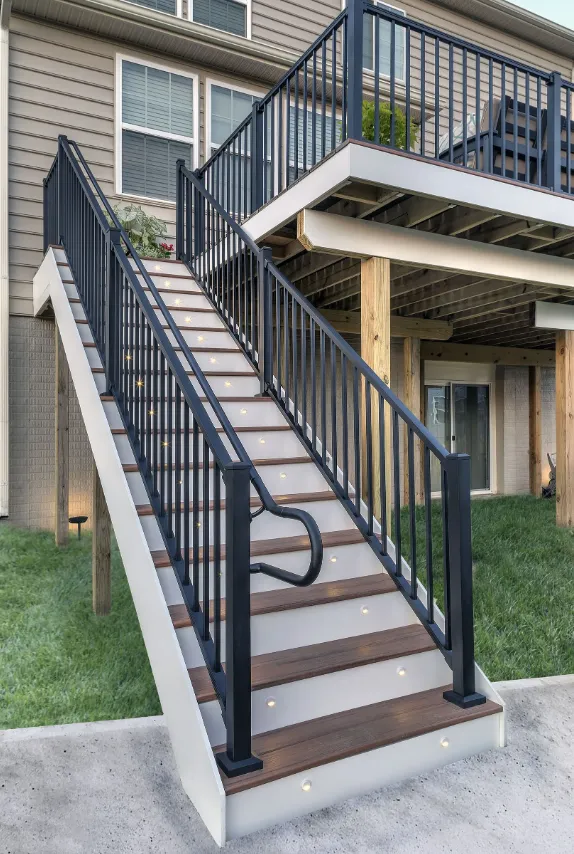
A stair handrail that shifts under your hand is not a cosmetic problem, and no amount of fresh paint will fix it. Pull it, set the posts properly, put up something a hand can close around. That was the fix at a single-story ranch in Williamsville last spring, where the owner replaced two failing wood runs with the pvc railing buffalo ny crews install on porches and step runs across the region. Her job made the case that gets made job after job here, that a properly footed, graspable rail costs far less than one fall.
The Loose Handrail Behind A Near Fall
The near miss came on a December morning, ice on the third tread. She reached for the rail on the way down, it traveled four inches with her, and she caught the storm door frame instead. Nothing broke. Her son tightened the lag screws that weekend and figured the job was closed.
Tightened lags almost never solve it. What usually turns up on a call like this is a sound top rail sitting on a post that has been working loose for years, because the footing was too shallow the day it went in. Frost gets under a shallow pier, lifts it, drops it, and repeats every winter until the assembly has play. The American Wood Council’s DCA 6 deck guide calls for footings at least 12 inches deep or below the frost line, whichever is deeper, and the second half of that requirement is the half people skip. Snow, salt and freeze-thaw chew through the painted wood above ground.
The rail never actually broke. It just stopped being something she could trust, which on an icy morning amounts to the same thing.
Where Graspable Handrail Rules Come From
Graspable means your fingers wrap the rail and meet your thumb, so a stumble catches you instead of sliding you along the top. Plenty of older porches in Erie County have a flat two by four laid across the balusters, which looks like a rail and works like a shelf. You cannot grip a shelf. A loose or ungraspable stair rail is a fall hazard and should not be relied on for another season: stop using those steps, have the rail inspected, and replace it to current local code, sized the way the U.S. Department of Justice’s 2010 ADA Standards for Accessible Design describe a round handrail, 1-1/4 inch minimum to 2 inch maximum outside diameter.
Those federal standards cover accessible facilities, not a private ranch house, and rules for one and two family homes are enforced locally. Ask your building department what applies before anybody sets a post. Carry the dimension into that conversation anyway, since an average hand can close around a rail that size and hold weight.
Then Versus Now On Handrail Upkeep
Ten years ago the answer to a bad rail was another wood rail, and everybody accepted the maintenance that rode along. Scrape, sand, prime, two coats, then do it again in two or three seasons, because a south-facing run burns off paint faster than the brochure suggests. Homeowners on a fixed retirement income felt that hardest: a few hundred dollars of labor, or a weekend on a ladder they had no business climbing. Now the job gets specified as a system. Look at what PVC railing Buffalo NY suppliers stock and you find sleeved posts, extruded rail sections, brackets, and a graspable rail that mounts to the run.
How long these systems hold up through a Western New York winter is the part I cannot give you straight. The extruded rails have not been on enough local porches long enough to produce thirty-year field data, and anyone quoting a hard lifespan number is borrowing it from a warmer state. What I can tell you is which repair calls come in during March, and they are for split wood and rusted iron.
The Cost Walked To A Real Number
Material choice moves the number less than people expect. The regional labor rate sets the floor, and that floor keeps climbing. Homewyse pegged a wood privacy fence at $33.07 to $53.00 per linear foot back in May 2026, a different product entirely, though a fair read on what installed outdoor work costs now. Rail runs are shorter and fussier per foot, with posts, brackets and a return at each end.
Preference has been drifting, and not only on price. A University of Massachusetts Building and Construction Technology study of the decking market reported that when homeowners considered building a new deck from scratch, their preference for pressure-treated wood fell to 62%. Upkeep is what most of them cited on the way out.
Run her steps as an illustration, since every set prices differently. Six feet of rail across the front run and four at the back gives ten feet of graspable rail. Say rail, posts and brackets land around $55 a foot installed, so $550 in system parts. Two footings dug below frost and poured at roughly $120 each adds $240, and half a day of labor at $340 brings the pair of runs to $1,130 all in, before the senior discount a lot of local shops quietly offer. Set that against one broken wrist and the follow-up care.
The Rail That Made The Steps Usable Again
Both runs went in over a single April morning. She takes the back way down now with a coffee mug in one hand and the rail in the other, which is the entire point. Nothing needs painting, and the posts sit deep enough that next winter can do its worst. If a rail on your own steps has play in it, the question is not what it costs to make it look better. It is what a proper footing and a real grip would run, and how much of the house you get back the day it goes in.