

The Challenge: Why Subcontractor Control Breaks Down
Subcontractors are often one of the largest cost categories on a construction project and, at the same time, one of the hardest areas to control. When agreements, advance payments, work certificates, retention amounts, invoices, and approvals are spread across spreadsheets, email chains, and disconnected tools, contractors lose visibility fast.
For companies in the UAE running several sites at once, this fragmentation quickly leads to delayed decisions, weak cash planning, and budget overruns.
How do I manage subcontractors on a construction project?
The proper answer is to manage every subcontractor inside one controlled workflow that starts with defining scope and ends with final settlement. That workflow should capture contract value, payment rules, advance recovery logic, retention terms, work progress, approvals, and actual payments,all in one place.
This practice is one of the most effective for subcontracting success because it helps contractor teams identify issues early, set clear expectations, and handle every party according to the same rules. In practice, the main reasons for failure are rarely dramatic. More often, they come from breaks in process: the project team approves extra tasks before documentation is updated, finance releases an advance without seeing the remaining commitment, consultants certify work on one file while the commercial team uses another, or scheduling, costs, materials, and progress are managed in separate systems.
If these elements are not synchronized, the business cannot master subcontractor control effectively. That is why helpful methods begin with one shared source of data.
Why do contractors lose control of subcontractor costs?
Most overruns happen because companies cannot see commitments, actuals, and future liabilities together. Common visibility gaps include progress payments recorded but unpaid certified work missed, retention calculated manually and posted differently by operations and accounting, changes in scope staying outside the approved budget long enough to damage margin, and management understanding the result only by month end,too late to protect it.
A better approach is to connect each subcontract to the live project budget. Contractors need to understand not only what has been paid, but also what has been committed, what has been certified, what has been retained, and what is still expected to be paid. If the system cannot compare budget, executed work, and remaining obligations in real time, it becomes difficult to stay in control. This is where construction software adds real value: it helps teams use daily data, not old reports, to make practical decisions.
For many contractors, the best construction ERP is the one that connects commitments, progress, and cash in real time.
How can construction companies track subcontractor costs against the project budget?
For real control, subcontractor expenses must be linked to the project, cost code, package, or BOQ item from the start. Each transaction should be clearly linked to the total subcontractor obligation: each advance payment visible as part of total obligation and then recovered under contract logic, each interim valuation updating executed value, each retention deduction remaining visible until release, and each approved variation updating budget and forecast rather than waiting for month-end reconciliation.
When those links are missing, cost reports look complete but still hide risk. The most useful indicators are simple but powerful: contract value, advance paid, advance recovered, certified work, retention withheld, paid amount, outstanding commitment, budget deviation, and forecast to completion. These indicators help project managers understand whether subcontracting is supporting profitability or quietly eroding it. They also protect leadership from false confidence created by cash-only reporting. A company may feel safe because payments look controlled, while certified liabilities and pending variations are already moving the job off plan.
What should be included in subcontractor management software for UAE contractors?
Modern software for UAE contractors should cover the full subcontract lifecycle, from contract award to final account. This includes defining commercial terms, storing documentation, tracking work progress, controlling advances, calculating retention automatically, routing approvals, linking costs to projects and BOQ, and producing financial and management reporting. A system that only records invoices is not enough. The best tools support operational control and commercial control together.
Local needs also matter. UAE contractors often operate with multilingual teams, several active projects, and cross-border purchasing or subcontracting arrangements. They also need VAT-ready processing,since VAT applies to taxable supplies in the UAE at 5%, with registration required once taxable supplies and imports exceed AED 375,000 ,and Wage Protection System compliance, as private-sector employers in the UAE are required to pay wages through WPS. In short, the software should not only manage subcontractors; it should also ensure compliance and support daily execution.
How ERP helps automate subcontractor management
A modern construction ERP brings contracts, commitments, progress, and payments into one system. It creates a single base for defining scope, roles, tasks, and commercial conditions; automates payment workflows so advances, interim certificates, and retention follow the contract instead of manual calculations; connects each subcontract to project profitability, helping teams understand where value is created and where risk is building; and improves reporting for project managers, finance teams, and owners.
This matters because subcontractor control usually breaks where projects move fastest. Teams need to learn from live data, not from reports compiled long after the facts. The right ERP helps contractors optimize approvals, transfer information from site to office without duplication, and protect margin through proactive mitigation. Whether a business is comparing Procore, NetSuite, or other tools, the key question is the same: can the system handle contracting realities, keep documentation in one cloud environment, and support better decisions every day?
How FirstBit ERP helps contractors in the UAE manage subcontractors in one system
FirstBit ERP positions its solution specifically for contractors and construction companies in the UAE. The company says its construction ERP system unites departments in one software environment, synchronizes site progress with operations, and helps projects stay on schedule and within budget. The platform includes project cost control, project management, procurement, finance management, accounting, taxes, HR and payroll, warehouse management, and other modules inside one synchronized system.
The company also describes construction software directly on its site, including features for agreements, payments, retention, and integration with project schedules and budgets — which is better suited to subcontractor control than generic systems. FirstBit ERP describes billing and financial controls such as progressive or milestone-wise invoicing, retention settlement management, real-time cash flow tracking, and transparent reporting on project progress and costs. It also provides project and budget controls including cost control across materials, labor, equipment, and subcontractors; BOQ-based estimating; project P&L; budget variance analysis; completion analysis; and multi-level approvals. Those capabilities are important because subcontractor control is not just about paying bills; it is about understanding the commercial impact of every subcontract package.
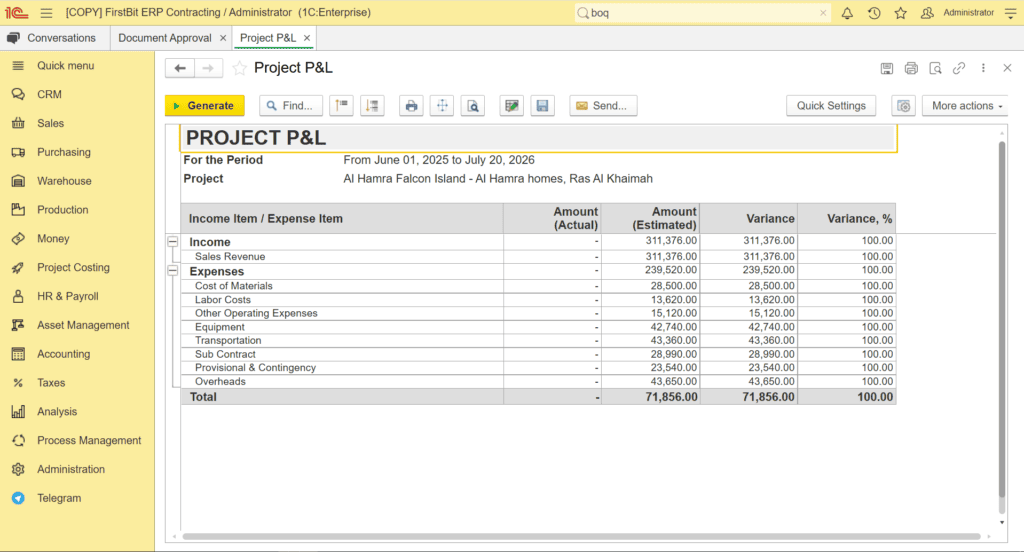
Project P&L Overview in FirstBit ERP
For UAE contractors, FirstBit ERP adds local features that many generic platforms do not define well out of the box: compliance with Federal Tax Authority requirements, automated VAT reporting, support for corporate tax workflows, Arabic and English support, WPS-related payroll functionality, and multi-currency accounting with automatic rate updates from the Central Bank of the UAE. Explore how FirstBit ERP can better support contractors managing multiple projects and working with mixed supplier structures.
Transparent subcontractor management starts with one system
The primary lesson is clear: subcontractor problems are usually data problems before they become financial problems.
If contract terms, advance payments, retention, certified work, and budget impact are managed separately, the contractor loses:
– Time
– Accuracy
– Negotiating strength
If they are managed together, the business can:
– Understand exposure earlier
– Use better strategies
– Build a more reliable path to project success
For that reason, many contractors now look for one ERP that combines contracts, payments, retention, and reporting in a single workflow.
For companies in the UAE, FirstBit ERP presents itself as a practical option built around contracting operations rather than generic back-office accounting. That makes it a relevant choice for firms that need:
– Stronger visibility
– Better reporting
– More disciplined subcontractor management