
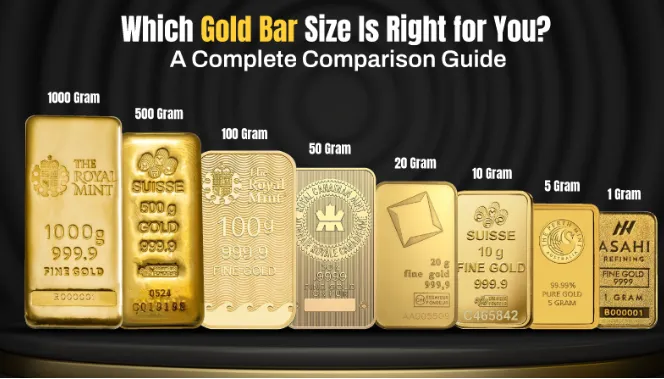
Investing in physical gold has been like the oldest trick in the book for wealth preservation, protection against inflation, and initiating generational wealth. Having resolved to invest, a useful follow-up question is:
What size gold bar do I need?
From 1 gram gold bars to large 1 kilogram bars, every weight serves a unique purpose. Selecting the correct weight will impact your budget, premiums, storing, liquidity, and future flexibility.
Here, we’ll also contrast the most widely used gold bar weights—discussing their advantages and disadvantages and best usage. As a new buyer or seasoned stacker, this should help you make the optimal choice.
Understanding Gold Bar Sizes at a Glance
Gold bars have various sizes, which vary from as low as 1 gram to 1 kilogram. Beginners or for gifting like small ones such as 1 g, 5 g, or 10 g since they are not too expensive, whereas moderate sized ones such as 50 grams, 100 grams, and 1 oz are used by investors so that they can accumulate their wealth effectively.
Large 250g, 500g, and 1kg bars are preferred by institutions or high-net-worth buyers since their premium is less per gram. All of them are used for various purposes, and the right one depends on your purpose, price, and liquidity level.
The Appeal of 1 Gram Gold Bars: Entry-Level Accessibility
Pros:
- Lowest cost per bar – Ideal for gift-givers or a beginner
- Most versatile – Simple to resell in small quantities
- Ideal for dollar-cost averaging – Purchase incrementally over time
- Tiny and portable
Cons:
- Highest premiums—The cost per gram is dramatically higher because of minting and packaging.
- More suited for retail investment—purchasing lots of small bars equates to unnecessary markup.
Considerations before Investment:
- 1 gram gold bars are perfect for new investors, budget-conscious buyers, or anyone who wants to present physical gold as a gift.
- They’re not best for stacking significant quantities, but they’re incomparable when it comes to flexibility and convenience.
10 Gram to 20 Gram Gold Bars: The Next Step Up
As soon as you go up from 1 gram bars, the premiums start to decrease a bit, and the gold weight is more significant.
Advantages:
- More gold content with greater value per gram
- Still quite cheap
- Preferred by small investors and collectors
Disadvantages:
- Still maintain high premiums
- Less resale than for more conventional weights
Considerations before investment:
- They are good stepping stones for investors who desire more weight than fractional bars but not necessarily larger investment amounts.
Spotlight: Why 50 Gram Gold Bars Strike the Right Balance?
50 gram gold bars are popularly called the “sweet spot” of the bullion market. They provide value, investment value, and affordability all at once.
Advantages:
- Lower premiums than smaller bars
- More gold for a dollar without breaking the bank
- Produced by leading mints such as PAMP, Valcambi, and Perth Mint
- Extremely liquid and IRA-compliant
Disadvantages:
- Less convenient than 10g or 1g bars when selling in an emergency
- Still a premium over 100g and larger bars
Considerations before investments
- If you’re looking to build wealth with physical gold without tying up thousands of dollars, 50 gram gold bars offer a smart middle ground.
- They’re excellent for long-term holding, stacking, or portfolio balancing.
100 Gram and 1 oz Gold Bars: Popular Among Serious Stackers
These weights are probably the most widely traded and owned by individual investors.
Advantages:
- Lower premiums
- Global acceptance
- Easy to sell
- Satisfactory balance of value and flexibility
Disadvantages:
- More expensive to buy ahead of time than 50g or lighter weight bars
- Less flexible for fractional liquidation
Usage:
Best for serious investors who would like to build up a gold reserve with some flexibility. The 1 oz bar is particularly popular in America because it is familiar.
Large Format: 250g to 1 Kilogram Gold Bars
The larger 250 grams to 1 kilogram gold bars are well-suited for institutional investors or high-net-worth clients who want to store big value in a tight space.
Advantages:
- Lowest premiums by the gram
- Perfect for wealth preservation
- Occupies very little space in proportion to their worth
Disadvantages:
- Very costly per unit – One bar is $60,000+
- Less liquid – More difficult to sell half of
- Not best suited for new investors
Application:
Large gold bars are most appropriate for long-term owners or securely storing value. They are not suitable for short-term sale or small-size diversification.
Gold Bar Sizes Comparison Table
| Bar Size | Approx. Value (USD)* | Premium | Liquidity | Ideal For |
| 1 gram | $85–$110 | High | Very High | Beginners, gifting |
| 10 grams | $750–$900 | Medium | High | Entry-level investors |
| 50 grams | $3,800–$4,200 | Low-Mid | High | Long-term individual stackers |
| 100 grams | $7,500–$8,300 | Low | High | Experienced investors |
| 1 kilogram | $74,000–$83,000 | Very Low | Medium | Institutional or HNW buyers |
*Prices are approximate and based on June 2025 spot prices.
How to Choose the Right Size for You
Before investing in gold bars and choosing the right size, it’s necessary that you have a clear objective and mindset. It’s necessary that you question yourself first to get a clear understanding of your purpose of investment.
How much are you planning on spending?
When you’re scaling down, fractional 1g–10g bars are wonderful. For best value, begin at 20g or 50g and upwards.
What are you doing this for?
Stacking for retirement, gift-giving, or reserve liquidity? Your size needs to be appropriate to your purpose.
How vital is resale liquidity?
Small bars are more liquid but more expensive per gram. Large bars are cheaper per gram but harder to divide.
Are you purchasing a Precious Metals IRA?
Choose IRS-qualified weights (usually .995+ purity) and check mint eligibility—50 g, 100g, and 1 oz bars from trusted mints like PAMP Suisse, Royal Mint, Scottsdale Mint, and others are usually eligible.
Tips of Purchasing Gold Bars (Any Weight)
- Always buy through reputable dealers with insured shipping and transparent pricing
- Choose bars with assay cards or tamper-evident packaging
- Choose trusted and reputed mints (PAMP, Valcambi, Perth Mint, Royal Canadian Mint)
- Check the gold spot price today or the day of buying, and the dealer’s premium over spot price before buying.
- Store in a safe, fireproof location—home safe or safety deposit box is a consideration.
Conclusion: Match Your Bar to Your Plan
No one size fits all for gold bars. A 1 gram gold bar may be appropriate for the newcomer, while a 50 gram gold bar may be the best choice for those who want deep value without paying tens of thousands.
Consider gold bar sizes as tools—every tool is used for a purpose. The thing is, finding the right size to apply to your strategy, whether it’s buying often, holding long-term, giving as gifts, or diversifying a larger investment strategy.
If unsure, combine a few weights to enjoy flexibility, lower premiums, and optionality at resale.